
Home > Blog >
Finding a reliable OEM Interactive Display manufacturer requires more than checking prices. B2B buyers need stable quality, flexible customization, and dependable technical support. Moreover, a qualified interactive display manufacturer should support product development and regional market requirements.
For distributors, brand owners, and project integrators, these capabilities influence product consistency and long-term operating costs. Therefore, buyers should evaluate hardware configuration, touch performance, software localization, and factory quality control before placing bulk orders.
China Chip Depot (QDE) provides OEM, ODM, SKD, and CKD customization services for interactive smart displays and touch panels. Its solutions support educational projects, corporate meeting rooms, and private-label product programs.

Product quality directly affects installation, daily operation, and after-sales workload. Therefore, buyers should examine the manufacturer’s inspection procedures and production controls.
A qualified OEM Interactive Display manufacturer should define inspection points throughout production. These may include incoming component checks, assembly inspections, functional testing, and final product verification.
Additionally, buyers should request documented acceptance criteria. These records help purchasing teams evaluate consistency across production batches.
For large-format interactive whiteboards, verify touch response, display uniformity, audio output, connectivity, and operating-system stability. Also, confirm that the factory can track key components and manage engineering changes.
QDE supports factory quality control, production oversight, and component traceability. These practices help B2B customers manage product consistency and lifecycle requirements.

Hardware selection affects application compatibility, user experience, and total procurement cost. Consequently, buyers should match computing resources to actual usage requirements.
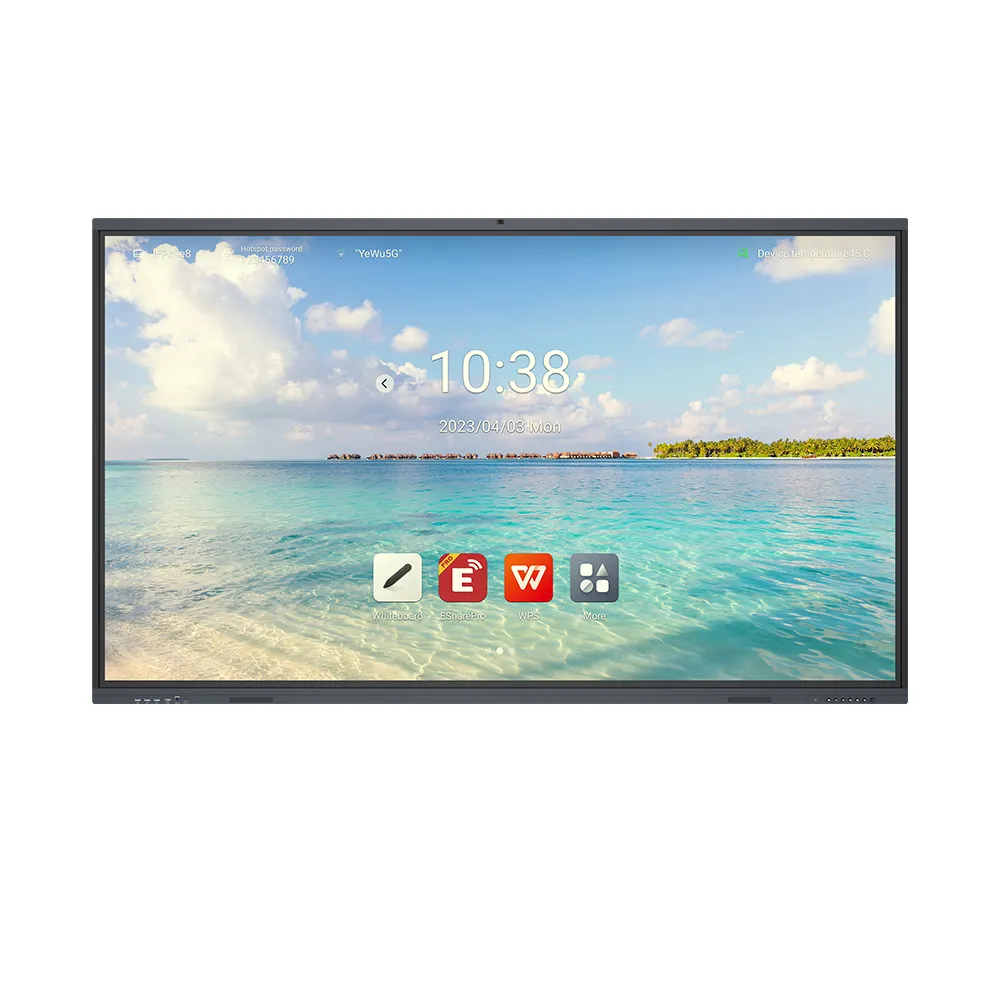
A 105-inch interactive whiteboard can serve classrooms, training facilities, and large meeting rooms. However, buyers should confirm room dimensions, viewing distance, installation access, and mounting requirements before ordering.
Infrared touch technology supports multi-user interaction. In this case, the specified 40-point infrared touch system can accommodate collaborative writing and annotation workflows.
Meanwhile, Android versions and memory configurations influence application compatibility and multitasking capacity. The 105-inch model supports Android 11, 12, 13, or 14 configurations. Its standard memory configuration is 4 gigabytes of RAM and 32 gigabytes of ROM. Higher configurations can reach 8 gigabytes of RAM and 128 gigabytes of ROM.
The final configuration should reflect software requirements, target markets, and project budgets. This approach helps buyers balance functionality with cost efficiency.

A reliable custom interactive display supplier should explain how each feature supports the intended workflow. Therefore, buyers should assess technical specifications against classroom and meeting-room requirements.
Zero bonding technology can support a streamlined display structure. Upgraded audio can also improve presentations and classroom communication.
Furthermore, full-function Type-C connectivity can simplify connections with compatible devices. Buyers should confirm supported functions, power delivery, and data transmission requirements.
| Evaluation item | QDE 105-inch model | Buyer verification point |
|---|---|---|
| Display size | 105 inches | Confirm installation space |
| Operating system | Android 11, 12, 13, or 14 | Confirm software compatibility |
| Memory | 4 gigabytes RAM and 32 gigabytes ROM; up to 8 gigabytes RAM and 128 gigabytes ROM | Select the required configuration |
| Touch system | 40-point infrared touch | Test collaborative workflows |
| Display construction | Zero bonding technology | Confirm the panel structure |
| Connectivity | Full-function Type-C | Verify supported functions |
| Audio | Upgraded audio | Assess room acoustics |
| Compliance | Market-dependent | Request applicable test reports and certificates |
Use these specifications as a starting point for procurement. Final configurations and compliance documents should be confirmed before production.
For additional product options, explore the Interactive Display Product Range.
Private-label projects often require more than a logo change. Instead, buyers may need adjustments to hardware, packaging, firmware, and user interfaces.
A capable OEM Interactive Display supplier should align customization with your product roadmap. QDE offers several cooperation models for different project requirements.
OEM: Customize products around your brand and agreed specifications.
ODM: Adapt an existing platform or develop a tailored product solution.
SKD: Support semi-knocked-down assembly arrangements.
CKD: Support completely knocked-down product arrangements.
Additionally, QDE offers custom chassis designs, touch technologies, computing modules, and board configurations. Buyers can also request branded packaging, manuals, and marketing materials.
Software localization supports languages such as Spanish, Arabic, and Indonesian. Meanwhile, engineering teams can coordinate functional, aesthetic, and regulatory requirements.
This flexibility helps distributors build recognizable product lines. It also allows integrators to align equipment with specific project needs.
Explore the Interactive Display Technical Guide for related technical planning topics.

Purchase price alone cannot determine total procurement value. Buyers should also consider configuration suitability, production consistency, customization expenses, and after-sales requirements.
Start by defining essential functions and acceptable performance criteria. Then, ask the manufacturer to document the approved bill of materials and configuration.
Next, establish sample approval procedures and production inspection requirements. These steps help both parties manage expectations before bulk manufacturing.
Buyers should also request quotations based on comparable configurations. For example, memory capacity, accessories, packaging, software localization, and order quantity can influence the final price.
QDE supports distributors, brand owners, and project integrators through flexible customization services. Its engineering coordination and private-label options help customers plan products around commercial requirements.
For larger deployments, discuss spare parts, warranty terms, and technical support before signing the agreement. A clear service plan can also help manage long-term operating costs.
Request a detailed specification sheet, a sample evaluation plan, applicable compliance documents, and written quality criteria. Also, confirm customization scope, delivery terms, and after-sales responsibilities.
Not necessarily. Its suitability depends on room dimensions, viewing distance, installation conditions, and teaching methods. Buyers should assess the site before selecting the display size.
Yes. QDE offers OEM, ODM, SKD, and CKD services. Options include hardware configuration, packaging, language localization, and private-label branding.
Choose specifications that match actual project needs. Then, evaluate quality controls, customization costs, service terms, and batch consistency together.
China Chip Depot (QDE) supports customized interactive displays for education, corporate meetings, and integration projects. Its flexible configuration options and coordinated engineering support help B2B buyers develop suitable branded solutions. Contact QDE to discuss your requirements and request a project-specific quotation.

 Hot News